
Wheaton Epoxy Flooring installs polyaspartic floor coating systems in Wheaton, IL, serving surrounding cities including Winfield, Warrenville, Hinsdale, Wood Dale and Bensenville, with more than 20 years spent preparing and coating concrete. Polyaspartic is the fast-curing, light-stable member of the coating family, and it earns its place where downtime, sunlight or a cold season would hold up a standard epoxy floor.
Speed is the feature people hear about, but speed only helps when the slab underneath is right. Every polyaspartic floor we install starts with diamond grinding, a moisture test written into the scope and a crack and spall map, because a coating that cures in hours fails just as fast as any other on a poorly prepared surface.
The proposal names the product line, the number of coats and the finished thickness, so you can check the floor you get against the floor you were quoted. If a full polyaspartic system is not the best fit for your slab, we say so and explain the alternative.
What Polyaspartic Coatings Do Well
Fast Return to Service
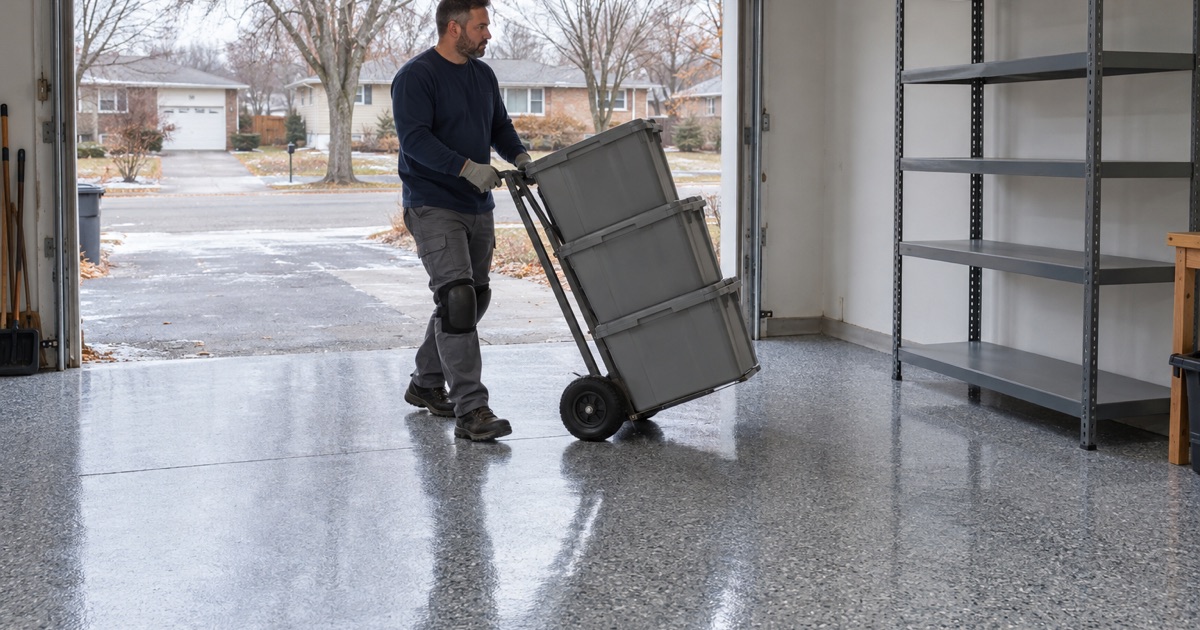
Polyaspartic cures in a fraction of the time standard epoxy needs, so floors can often take foot traffic within hours and vehicles much sooner than with an all-epoxy system. For a household with one garage or a business that cannot close for long, that shorter window is often the deciding factor.
That speed also lets us coat several areas in sequence and reopen each one quickly. For a clinic hallway or a restaurant back room, a section can be coated overnight and returned to staff the next morning.
Ultraviolet Stability
Standard epoxy ambers in sunlight. Aliphatic polyaspartic topcoats resist that yellowing, which is why they are the usual choice where daylight falls on the floor through an open garage door, a storefront or a large window. A light gray or white floor stays true near the door instead of turning a yellowed band.
That same stability makes polyaspartic a good final coat over metallic and flake systems, where the decorative layer underneath should keep its color for years rather than shift as the sun works on it.
Hardness Against Tires and Abrasion
A polyaspartic topcoat cures to a hard, abrasion-resistant surface that holds up well against hot tire pickup, dragged equipment and the grit that comes in with winter traffic. It is also resistant to many automotive fluids and road salt, which suits Wheaton garages through the brine season.
Hardness does not replace thickness, though. A polyaspartic topcoat over a thin, poorly bonded base can still lift under a hot tire, so the full system is specified as a whole, with the base build and the finished thickness written into the proposal rather than leaning on the topcoat’s reputation.
Polyaspartic Systems We Install
Epoxy Base With a Polyaspartic Topcoat
Our most common system pairs a 100% solids epoxy base with a polyaspartic topcoat. The epoxy builds thickness, wets into the ground concrete and gives a slower, more forgiving bond coat, while the polyaspartic finish provides the hard, light-stable wearing surface. It balances cost, durability and installation time.
The hybrid approach usually adds a day compared with a full polyaspartic floor, because the epoxy base needs time to cure before the topcoat goes on. For most homeowners that extra day is worth the added build and the longer working time the epoxy gives the crew on a large or irregular floor.
Full Polyaspartic Flake Floors
A full polyaspartic system uses polyaspartic for the base and topcoat with a vinyl flake broadcast between them. It can return a garage to service faster than any epoxy-based system and extends the season into cooler weather. The trade-off is a short working time, which demands experience and a crew that works in coordinated sections.
Full broadcast flake also hides dust and slab blemishes and adds light texture underfoot. Chip blend and size are chosen with you from physical samples, not a screen image, because flake colors look different under garage lighting.
Clear Polyaspartic Over Polished or Stained Concrete
A clear polyaspartic coat can protect stained or ground concrete where you want the look of the slab with the cleanability of a coating. It gives better resistance to salt and oil than bare concrete. It is a coating, though, so it can scratch and will need care at entries.
A clear coat also shows what is beneath it. Patches, old adhesive shadows and uneven grinding all remain visible through a transparent finish, so the slab is assessed honestly before this option is quoted, and a pigmented or flake system is suggested where the concrete itself is not attractive enough to show.
Installing Polyaspartic the Right Way
Surface Preparation Comes First
Polyaspartic penetrates and bonds quickly, which leaves no margin for a dirty or etched surface. We diamond grind or shot blast to the concrete surface profile the manufacturer calls for, degrease oil-stained areas and vacuum thoroughly. Grinding dust is captured at the machine rather than rinsed toward a drain or the street.
Moisture and Temperature Checks
Fast-curing coatings are often less tolerant of moisture coming through the slab. A test is included in every scope, using an ASTM F1869 calcium chloride kit or ASTM F2170 in-situ probes where needed, and a high reading calls for a moisture-mitigation primer under the system.
We also measure slab temperature and the dew point spread at the surface before each coat. A slab close to the dew point can hold a film of condensation that a polyaspartic will not bond through, whatever the calendar says.
Working Time and Crew Coordination
Polyaspartic gives a short window between mixing and the point where it can no longer be worked. We mix in small batches, work in planned sections and keep a wet edge so lap marks do not show. That coordination is why a polyaspartic floor should be installed by a crew that does it routinely.
On warm, humid days the working time shortens further, and a coating rolled too thick can trap bubbles as the slab outgasses. Applying in the cooler part of the day and keeping each coat within the maker’s thickness range avoids pinholes that would otherwise show in the finished surface.
Where Polyaspartic Fits Best
Garages Used Every Day
A polyaspartic or hybrid system suits a garage that is used daily, faces road salt all winter and gets sun through the door. The fast cure keeps the garage out of service for less time, and the topcoat keeps its color and gloss under heavy use.
For homes in the 1970s and 1980s housing stock common around Wheaton, the garage slab has often seen decades of salt, oil and patching. We map that damage first and repair it before the coating goes down, so the fast system is not asked to bridge problems it was never designed to fix.
Basements and Lower Levels
In basements, polyaspartic can coat laundry rooms, workshops and gyms quickly. Basement slabs need careful moisture testing first, and we read the floor for past water before choosing a system. A coating does not stop seepage or sewer backup, and we never sell it as radon mitigation, which is licensed work in Illinois.
Commercial Floors on Tight Schedules
Clinics, offices, restaurants and churches often have only overnight or weekend windows. Polyaspartic topcoats make those windows workable, with each section phased around opening hours so the space can reopen on time.
For a commercial job we provide the product data and the cure schedule in writing, so a facility manager knows when each area can take carts, foot traffic or equipment again. Where slip resistance matters, the texture is specified through the broadcast and an additive in the topcoat rather than left as a general promise.
- 20+ Years in Business
- Moisture Tested Before Pricing
- Free Written Estimates