
Wheaton Epoxy Flooring has installed epoxy garage floor systems for more than 20 years in Wheaton, IL, serving surrounding cities including Winfield, Warrenville, Hinsdale, Wood Dale and Bensenville. Each garage starts with the slab itself: we grind it, test it for moisture and map every crack before a single coat is quoted.
A garage floor in DuPage County takes a beating most indoor floors never see. Tires drag in road brine and rock salt from late fall to spring, warm tires sit on the coating after every drive, and many garages here run unheated through January. The system we install is chosen around those conditions rather than around a showroom sample.
Your written proposal lists the product line, the number of coats and the finished thickness, so you can measure the floor you receive against the floor you paid for. If the slab is too far gone to coat, we say that before you spend money on a finish.
Preparing a Garage Slab for Epoxy
Diamond Grinding to a Real Surface Profile
Acid etching leaves a thin, uneven surface and acid residue that can work against the bond. We open every garage slab with a diamond grinder, or a shot blaster on larger floors, to a concrete surface profile in the ICRI CSP range the coating maker calls for. The coating then locks into sound, open concrete instead of a weak top skin.
Grinding also removes old paint, sealers and kit coatings in the same pass. The grinder runs with a vacuum attached, so the dust is captured at the head rather than swept around the garage or hosed toward the driveway and the storm inlet at the curb.
Moisture Testing the Garage Slab
Wheaton adopted the 2024 International Residential Code through Ordinance O-2025-04 without changing section R506, which means the exception in R506.2.3 still lets a garage slab be poured with no vapor retarder beneath it. Many existing garages were built the same way, so ground moisture can move up through the concrete.
We test before pricing, using an ASTM D4263 plastic sheet as a screen and ASTM F1869 calcium chloride kits or ASTM F2170 relative humidity probes when we need numbers. A reading over the coating’s limit calls for a moisture-mitigation primer, which is cheaper than a floor that blisters in its first spring.
Cracks, Spalls and Salt Damage
Cracks, spalled joints and surface scaling are mapped on a drawing of the floor before work starts. Most are routed out and filled with a repair material that bonds to the coating system. Where a slab has settled, heaved or broken into loose pieces, we tell you plainly that it needs replacement rather than a coat of epoxy over the damage.
Replacing a garage slab is permit work in Wheaton, while coating an existing floor is not, so a replacement changes the schedule as well as the price. Knowing that before the proposal is signed keeps a coating job from turning into a concrete job halfway through.
Garage Floor Coating Systems We Install
Full Flake Broadcast Epoxy Floors
The most popular garage system is a 100% solids epoxy base with vinyl flake broadcast to full coverage, then a clear topcoat. The flake hides dust and minor slab flaws, adds light texture underfoot and builds thickness. Chip size and blend change the look from a fine granite effect to a bold speckle.
A full broadcast also gives the topcoat something to grip and spreads wear across the surface, which matters at the apron where tires turn on every trip in and out of the garage.
Polyaspartic Topcoats for Garage Floors
Standard epoxy ambers when daylight hits it through an open door, and it softens under a hot tire if it is too thin. A polyaspartic or polyurea topcoat over the epoxy base resists ultraviolet yellowing, cures faster and holds a harder surface against tire heat and dropped tools.
Polyaspartic is less forgiving to install than epoxy, so the topcoat is matched to the slab temperature and humidity on the day. That is part of why the dew point spread is checked before the clear coat goes down.
Solid Color and Quartz Garage Options
A solid color system costs less and suits a working shop or storage garage where a plain floor is fine. Quartz aggregate broadcast gives more texture than flake and is a strong choice where wet boots and snowmelt are a daily fact. We lay out samples of each so you can weigh look, grip and cost side by side.
Garage Floors Through a Wheaton Winter
Road Brine and Rock Salt Exposure
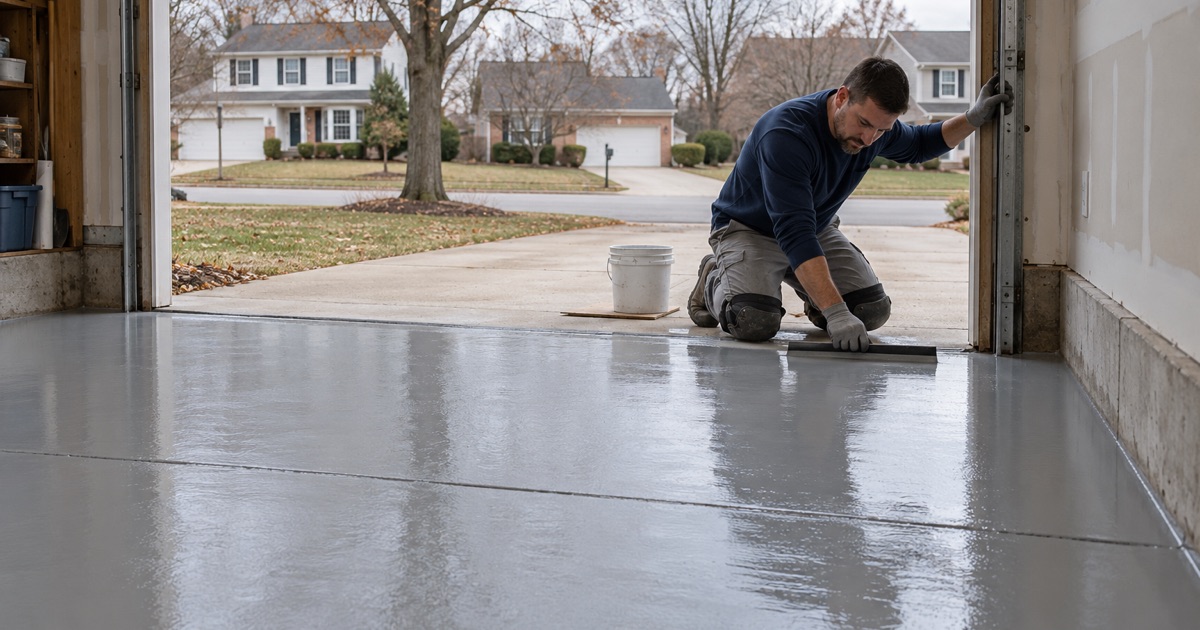
Calcium chloride and rock salt ride into the garage on every car from the first storm to spring. On bare concrete they soak in, recrystallize and scale the surface near the door. A coated garage floor keeps that salt on top, where it can be squeegeed out instead of eating into the slab.
The topcoat we choose has to tolerate repeated salt and brine contact without dulling or softening, so garage systems are picked with deicers in mind rather than only color and price.
Hot Tire Pickup and Thin Coatings
When a car pulls in after a drive, its warm tires press into the coating, and as they cool they can pull a thin film off the concrete. That is hot tire pickup. A ground slab, enough build thickness and a hard topcoat are what keep a garage floor from lifting in tire-shaped patches along each wheel track.
Store-bought kits are the usual victims, since they go down thin over an etched slab. When we remove a failed kit, the peeled areas almost always sit exactly where the tires park, which is the clearest evidence of how much thickness and bond a garage floor really needs.
Coating an Unheated Garage in Cold Weather
Epoxy needs a minimum slab temperature to cure properly, and an unheated garage can stay below it for weeks in deep winter. If the slab will not stay in range, we schedule your floor for a warmer stretch instead. Coating a cold slab risks amine blush, a soft surface and a weak bond.
The decision is made from readings, not the date on the calendar. We measure the slab temperature and compare the air’s dew point with the surface, because a slab within a few degrees of the dew point can collect a film of condensation that a coating will not bond through.
What an Epoxy Garage Floor Job Looks Like
Before the Crew Arrives
You receive a written proposal with the moisture result, the repair map, the product line, coat count and finished thickness. Home jobs over the Illinois threshold get a written contract and the Home Repair: Know Your Consumer Rights pamphlet before any grinding starts. We also confirm City of Wheaton registration and permit questions before scheduling.
Installation Days and Odor Control
Most two-car garages take two to three days. For attached garages, the door into the house is sealed, grinding dust is captured at the machine, and products are chosen inside the Illinois VOC limits for floor coatings. You get a clear schedule for when to stay off the floor and when the car can come back in.
Caring for the Finished Floor
A coated garage floor cleans with a broom, a squeegee and a mop with mild cleaner. In winter, pushing salty slush out the door every few days keeps grit from wearing the topcoat. We walk you through care and the warranty exclusions, moisture first, before we leave.
- 20+ Years in Business
- Moisture Tested Before Pricing
- Free Written Estimates