
Wheaton Epoxy Flooring installs commercial epoxy flooring in Wheaton, IL, serving surrounding cities including Winfield, Warrenville, Hinsdale, Wood Dale and Bensenville, and brings more than 20 years of concrete preparation and coating experience to every building. Commercial floors take more traffic, harsher cleaning and tighter schedules than a home garage, and the system and the plan both have to account for that.
Wheaton is the DuPage County seat, and its commercial floors are mostly in government offices, schools, colleges, healthcare, churches, retail and service businesses. Each brings its own demands, from daily disinfectant mopping to cart traffic and wet entryways. We start with how the floor is used and cleaned, then build the system from there.
Every commercial proposal names the product line, the number of coats and the finished thickness, and includes a written schedule built around your operating hours. Surface preparation is always mechanical, with diamond grinding or shot blasting rather than acid etching, and moisture testing is part of the scope before the price is final.
Commercial Floors by Facility Type
Clinics, Medical Offices and Rehab Spaces
Healthcare spaces are cleaned with disinfectants every day, and floors in exam rooms, corridors and therapy areas have to stand up to that chemistry without dulling or softening. We use seamless epoxy systems with chemical-resistant topcoats, and integral cove bases where liquids should not reach the wall joint. The result is a floor without grout lines or seams for contamination to collect in.
We ask the facility for the cleaning products in use before choosing a topcoat, because resistance charts vary by product. A system that handles one disinfectant well may haze under another, and that is far better to learn from a data sheet than from a floor.
Offices, Mechanical Rooms and Storage Areas
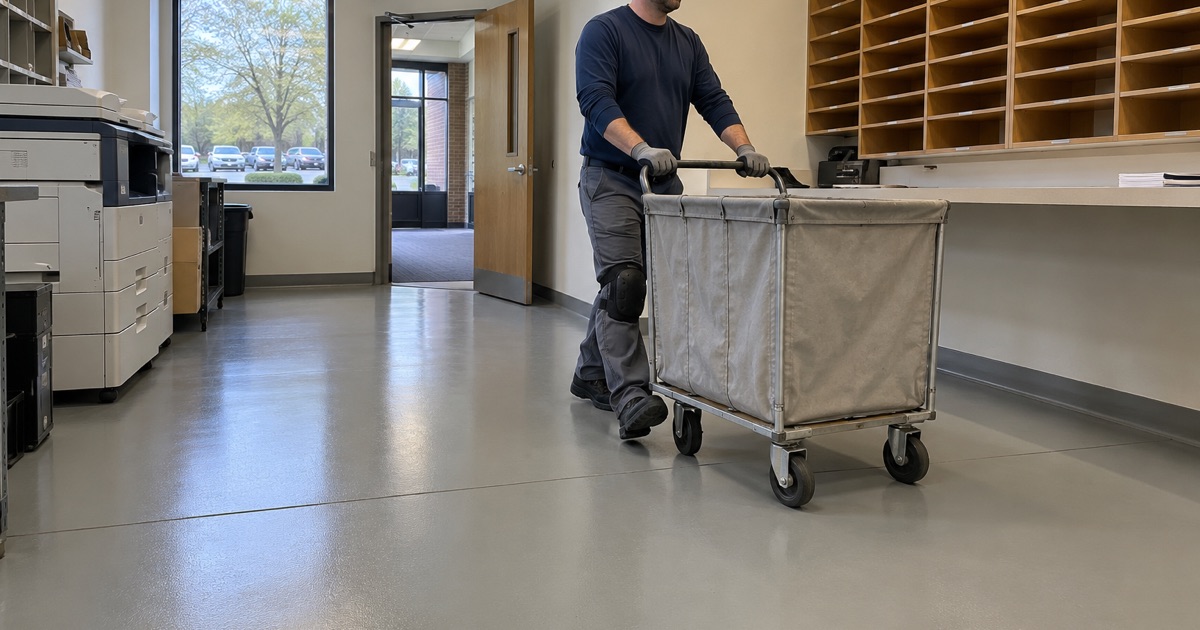
Office buildings carry back-of-house spaces that rarely get attention until the floor fails: mechanical rooms, janitor closets, storage rooms and loading areas. These floors see carts, equipment, leaks and dropped tools. A hard, chemical-resistant epoxy system keeps dust down, makes leaks easy to spot and cleans quickly, and we prepare these slabs to a heavier profile where wheels run.
Schools, Colleges and Churches
Schools, colleges and churches need durable floors in hallways, locker rooms, kitchens, fellowship halls and maintenance areas. They also cannot close in the middle of a term or a service schedule. We plan these jobs around breaks, weekends and the gaps between services, and phase the work so each area reopens as soon as it cures.
Kitchens in schools and churches also fall under DuPage County Health Department plan review, which asks for a smooth, nonabsorbent, easily cleanable floor and a coved base sealed at the wall. Those requirements shape the system choice from the start, so a fellowship hall kitchen is not specified the same way as the hallway outside it.
Gyms, Retail and Service Businesses
Fitness spaces need floors that handle dropped weights and daily sanitizing, with texture for grip. Retail and service businesses want a durable, attractive surface that holds up to foot traffic and carts. Decorative flake, quartz and metallic systems can deliver a finished look while still meeting the practical demands of a busy space.
Auto repair bays and fleet garages are a category of their own. Hot tires, oil, brake fluid and dropped tools call for a thick, chemical-resistant build, and oil-soaked concrete has to be degreased and ground clean first, because no coating bonds to a slab that keeps wicking oil back to the surface.
Systems for Commercial Use
Epoxy With Chemical-Resistant Topcoats
Most commercial floors use a 100% solids epoxy base for build and adhesion, with a polyaspartic, polyurea or urethane topcoat chosen for wear and chemical resistance. The topcoat is where cleaning chemicals, abrasion and ultraviolet light do their work, so it is selected for the specific conditions of each space rather than defaulting to the cheapest option.
Urethane Cement for Heat and Washdown
Where floors face hot water, steam cleaning or thermal shock, such as commercial kitchens and washdown areas, urethane cement outperforms standard epoxy. It is thicker, tolerates heat and handles more slab moisture. We recommend it where an epoxy would soften or lose its bond under those conditions.
Urethane cement is usually installed thicker than a standard coating and finished with a textured surface, so it also suits areas where carts, kettles and floor drains sit together. The trade-off is a more industrial look and a higher cost per square foot, which is why we confine it to the rooms that really need it.
Slip-Resistant Broadcast Systems
Entries, kitchens, locker rooms and ramps need grip. Quartz aggregate or vinyl flake broadcast and texture additives in the topcoat set how slip-resistant the surface is. We match texture to the cleaning method, since a very aggressive texture can be hard to mop clean, and an easy-to-clean surface can be too smooth for a wet floor.
Planning Around a Working Building
After-Hours and Phased Installation
When a business must stay open, we work nights and weekends and divide the floor into phases. Each phase is prepared, coated and cured before traffic is routed back onto it, and fast-curing topcoats shorten the time each area is out of service. The schedule is written so managers can plan staff and customer routes.
Phasing also covers the order of the work. Grinding, the loudest and dustiest step, is grouped into the hours when the building is emptiest, while the quieter coating steps can sometimes run closer to opening time.
Dust, Odor and Air Quality
Grinding dust is captured at the machine with vacuums rather than swept or rinsed into floor drains. Wheaton lies in the Chicago 2015 ozone nonattainment area, and the Illinois VOC limits for floor and industrial maintenance coatings bind the person applying the product, so every coating we use is picked inside those limits. Ventilation is planned around occupied areas so odor does not carry into offices or patient rooms.
Documentation and Maintenance
At the end of the job, facility staff receive the product data, cure schedule and care instructions. That makes it easier to choose compatible cleaners, train custodial teams and plan a future recoat. A commercial floor that is maintained correctly lasts longer and keeps its appearance between scheduled refreshes.
- 20+ Years in Business
- Moisture Tested Before Pricing
- Free Written Estimates