
Wheaton Epoxy Flooring provides concrete grinding in Wheaton, IL, serving surrounding cities including Winfield, Warrenville, Hinsdale, Wood Dale and Bensenville, and it is the foundation of every floor we have installed in more than 20 years. Whether the slab is getting an epoxy system, a polished finish, an overlay or new tile, the grinding decides how well everything above it holds.
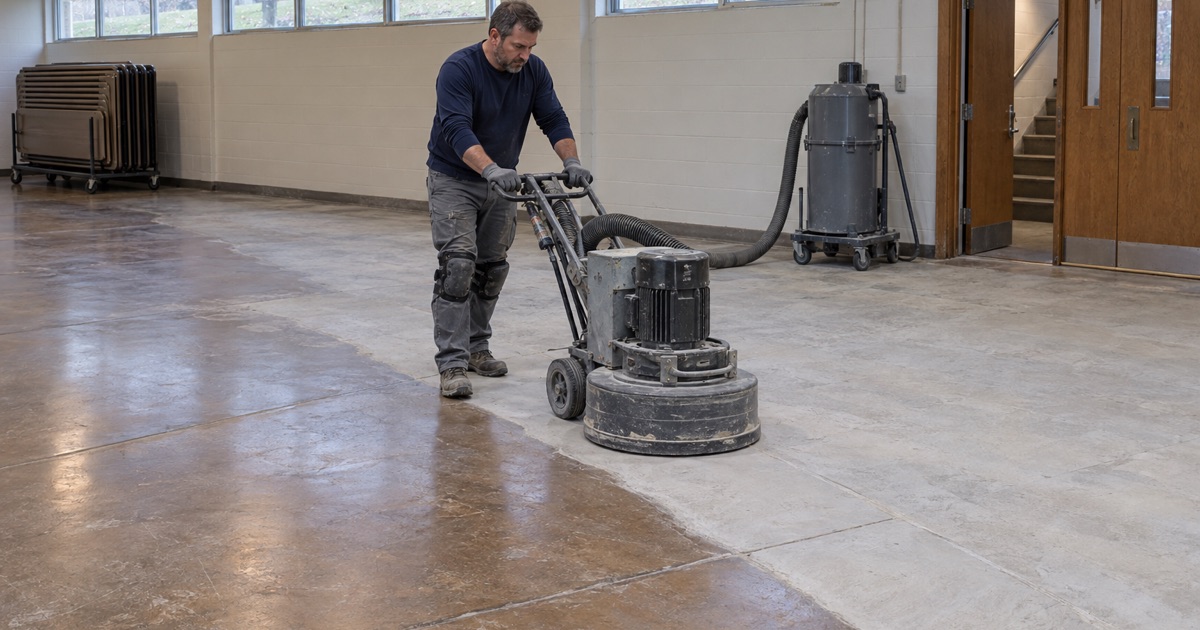
Grinding uses rotating heads fitted with diamond segments to cut into the top of the slab. It removes the weak cream layer, old coatings, paint and adhesives, and leaves a textured surface with open pores. That texture, called the concrete surface profile, is what a coating bonds to, and getting it right is the single biggest factor in whether a new floor stays down.
We never rely on acid etching to prepare a slab. Acid cannot remove coatings or glue, leaves uneven results and adds residue to the concrete. Every slab we prepare is opened mechanically with a diamond grinder or a shot blaster, and the method is written into the scope.
Surface Profiles and Why They Matter
Understanding ICRI CSP Ratings
The International Concrete Repair Institute rates surface texture on a scale from CSP 1, nearly smooth, to CSP 10, very rough. Each coating maker states the profile its product needs, often in the low-to-middle part of that range for thin coatings and higher for heavy mortars and overlays. We grind to the profile the product calls for and compare the result against reference chips rather than guessing by eye.
Matching the Profile to the System
A thin sealer or densifier works on a light profile, while a thick epoxy build or urethane cement needs a deeper one to anchor. Too little profile and the coating has nothing to grip; too much and a thin coat cannot fill the valleys, leaving a rough finish or weak spots. That is why the planned system is chosen before grinding begins rather than after.
The profile also has to be even. A floor ground deeply near the door and lightly in the corners will take coating differently in each area, which shows up as thin spots, uneven sheen or a weak bond where the profile fell short. We check the whole floor before the first coat, including the edges and the area under where shelving or a workbench stood.
Grinding, Shot Blasting and Removal
Diamond Grinding
Diamond grinding is our standard method for garages, basements and most interior floors. Different diamond bonds and grits handle different jobs, from aggressive coating removal to light profiling of new concrete. Edge grinders reach along walls, around posts and into corners that a large machine cannot, so the profile stays consistent across the whole floor.
Grinding also takes down high spots, lippage at joints and ridges left by old patches. That improves flatness before coating, which matters most for decorative systems such as metallic epoxy where every wave shows in the finish.
Shot Blasting
Shot blasting fires small steel shot at the slab and recovers it with a magnetic separator and a vacuum. It is fast on large, open commercial floors and produces an even profile, especially for thicker systems. It is less suited to small rooms and edges, so many commercial jobs pair a shot blaster in the open areas with edge grinders at the walls.
Shot blasting suits floors headed for thicker systems such as urethane cement in a commercial kitchen or a heavy epoxy build in a shop. Its deeper, uniform profile gives those materials a strong mechanical anchor, and the steel shot is collected and reused rather than left on the floor.
Removing Coatings, Paint and Adhesives
Old epoxy, paint, sealers, carpet glue and black tile adhesive all have to come off before a new floor goes down. Thick or gummy materials load up diamonds quickly, so we use tooling designed to cut them rather than smear them. Old adhesives on older floors are assessed before removal, and the cost of removal is listed separately in the proposal.
Removal is also a test of what the old coating was hiding. Under a peeling garage coating we often find the reason it failed, such as an etched surface that never had a real profile, oil soaked into the slab or moisture pushing up from below. Finding that cause is what keeps the new floor from failing the same way.
Dust Control and Clean Work
Capturing Dust at the Machine
Concrete grinding produces fine dust that contains silica. Our grinders and blasters run with vacuums attached at the tool, so the dust is captured where it is made. We do not sweep it into piles or rinse slurry toward a floor drain or a storm inlet, which keeps concrete fines out of the drainage system.
Protecting Occupied Homes and Businesses
In an attached garage or a basement, we seal doors, stairways and return-air openings before grinding. In clinics, offices and restaurants, work is scheduled around opening hours, with overnight and weekend windows when a space cannot close. The goal is that the rest of the building does not know the floor is being ground.
Noise is part of that planning too. Grinders and blasters are loud, so in occupied buildings we agree on working hours in advance, and in homes we let you know which day will be the loudest so you can plan around it. The quieter work of repairs and coating follows once the grinding is finished.
What Grinding Reveals About a Slab
Cracks, Spalls and Weak Concrete
Grinding removes the layers that hide a slab’s condition. Cracks, spalled joints, soft or dusty concrete and old patch outlines all become visible. We map them as we go and repair them before the coating, and when a slab turns out to be too damaged to coat well, we tell you before the job continues.
Contamination and Moisture Clues
Oil stains that keep wicking back, dark damp patches and white efflorescence are clues that come to light during grinding. Oil-soaked areas are degreased and ground again until clean concrete shows, and signs of moisture lead to testing before any coating is applied. A moisture test is part of the written scope on every coating job, so these clues are confirmed with numbers rather than ignored.
- 20+ Years in Business
- Moisture Tested Before Pricing
- Free Written Estimates