
Wheaton Epoxy Flooring handles concrete floor repair in Wheaton, IL, serving surrounding cities including Winfield, Warrenville, Hinsdale, Wood Dale and Bensenville, and it draws on more than 20 years of opening slabs and seeing what is underneath. Cracks, spalls, scaling and old patches are mapped before any coating is quoted, because a floor finish is only as good as the concrete under it.
Many of the floors we see in Wheaton belong to homes built in the 1970s and 1980s, which means garage and basement slabs that have taken decades of salt, oil, settling and patchwork. Some need light filling before a coating, some need joint and edge rebuilding, and a few need to be replaced. Telling those apart before the job is sold is the most useful thing a floor contractor can do.
Our written proposal includes the repair map, the materials we will use and the reasoning behind each choice. When we believe a slab should be replaced rather than repaired and coated, that recommendation is in writing too, before you spend money on a finish.
Common Concrete Floor Damage
Shrinkage and Settlement Cracks
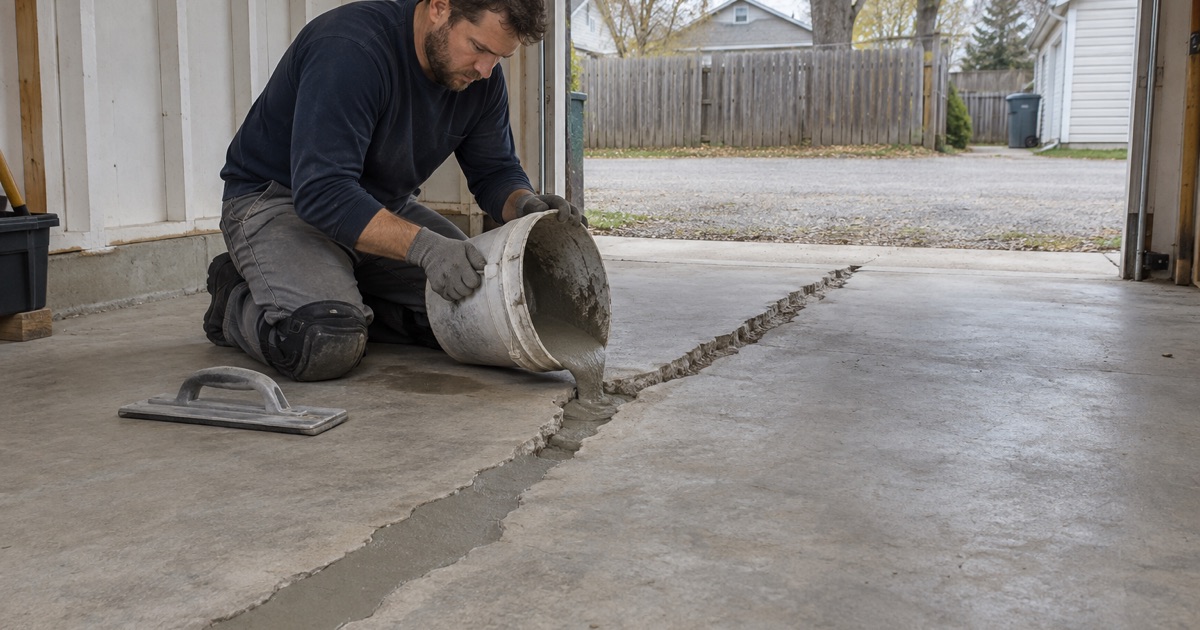
Thin cracks that wander across a slab are often shrinkage cracks from when the concrete cured, and many are dormant. Wider cracks with one side higher than the other suggest settlement or movement. We look at width, offset and whether the crack is still active, since that decides whether it gets a rigid filler, a flexible one or a closer look at the slab underneath.
Cracks that run straight in from a corner or follow a line of posts can point to stresses that are still working on the slab. Those are noted on the repair map with a plain explanation of what they mean for the finished floor, so you know what to watch for after the job.
Spalled Joints and Broken Edges
Control joints and slab edges take the most abuse, especially at a garage door where tires roll over the joint every day. Edges chip, crumble and widen over time. We cut back loose concrete to a sound edge and rebuild it with a repair mortar, so the joint is solid before any coating goes over or beside it.
In commercial spaces, forklifts and pallet jacks hammer the same joints thousands of times. Those joints often need a semi-rigid filler after the edges are rebuilt, which supports the wheels while still letting the slab move slightly with temperature.
Salt Scaling and Pitting
Road brine and rock salt carried into garages all winter soak into bare concrete and break up the surface as they dry and freeze. The result is flaking, pitting and exposed aggregate, usually worst near the door and under where cars park. Scaled areas are ground to sound concrete and resurfaced so the coating goes onto a smooth, solid base rather than into a field of pits.
Once repaired and coated, the slab is protected from the same damage. The salt that caused the scaling stays on top of the coating, where it can be squeegeed out the door, which is why a repair followed by a coating holds up far better than a patch left as bare concrete for another winter.
Repair Methods and Materials
Crack Filling and Routing
Cracks are routed open so the repair material has room to fill and bond, then cleaned with a vacuum. Dormant cracks get a rigid epoxy or polyurea filler that is ground flush once cured. Active cracks and moving joints get a material with some flexibility, or are honored with a joint in the coating, so movement does not tear the finished floor.
Patching Spalls and Holes
Deeper spalls, holes from old anchors and broken areas are filled with repair mortars or epoxy mortars suited to the depth. Thick repairs are built in layers when needed. Once cured, every patch is ground flush with the surrounding slab so it disappears under a flake system and causes no ridge under a smooth coating.
Patching material is matched to the coating that will follow. A repair that bonds poorly to epoxy or polyaspartic would create a weak spot in the middle of a new floor, so we use materials made to work under the system specified in your proposal.
Resurfacing and Leveling
Where a floor is badly worn, pitted or uneven across a wide area, a skim coat or self-leveling resurfacer can restore a smooth surface. This is common on older garage slabs with years of salt damage. Low spots and birdbaths that hold water can also be built up, though true slope correction for drainage is a larger concrete job.
Resurfacing does not fix a slab that is moving. If the base under the concrete has washed out or settled, the new surface will crack along with the old one, which is why we look at the cause before adding material on top.
When Repair Is Not Enough
Signs a Slab Should Be Replaced
Heaving, large sunken sections, slabs broken into loose plates and widespread deterioration that runs deep are signs repair will not hold. A coating over that kind of damage looks good briefly and then fails with the slab. We tell you plainly when replacement is the better investment.
Replacing a slab in Wheaton is permit work, while coating an existing floor is not, so a replacement changes both the timeline and the paperwork. Knowing that early lets you plan the concrete work and the coating together rather than discovering it halfway through a job.
Moisture, Water and Hidden Causes
Some cracks and spalls are symptoms of water moving through or under the slab. Basement floors in particular are read for past water and tested for moisture before repairs are finalized. A repair and coating do not stop seepage or hydrostatic pressure, and we say so rather than covering up a water problem that will return.
Oil is another hidden cause. Concrete that has absorbed years of drips can crumble at the surface and reject both repair material and coating, so oil-soaked areas are degreased and ground until clean concrete shows before any patch goes in. Spots that keep wicking oil back are flagged on the repair map.
- 20+ Years in Business
- Moisture Tested Before Pricing
- Free Written Estimates