
Wheaton Epoxy Flooring has spent more than 20 years putting down basement floor epoxy in Wheaton, IL, serving surrounding cities including Winfield, Warrenville, Hinsdale, Wood Dale and Bensenville. Basement work starts with a different question than a garage does: before we talk about colors, we read the floor for any sign of past water.
A basement slab sits in the ground, so moisture coming up through the concrete decides which system will last and whether the floor should be coated at all. A moisture test is written into every scope before the price is final, and the result is shared with you in plain terms rather than buried in a spec sheet.
The written proposal names the product line, the number of coats and the finished thickness, and it explains what the coating warranty leaves out, starting with moisture and hydrostatic pressure. That way you know what the floor will do, and what it will not, before you commit.
Reading a Wheaton Basement Before It Is Coated
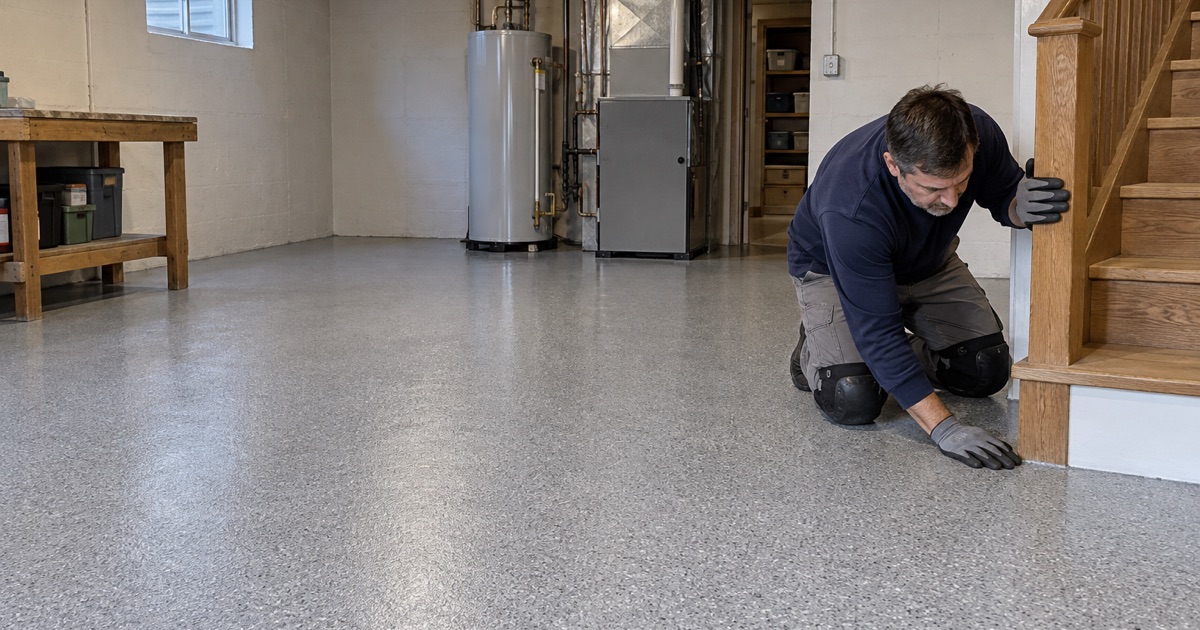
Signs of Past Water
Water stains along the walls, rust at the base of steel posts, tide lines on old paint and white powder on the slab all tell a story. We look for those signs on every visit and ask about past events, because a floor that has taken on water before can do it again if the cause has not been fixed.
If you have had seepage or a backup, the source needs attention first, whether that means a plumber, a drainage fix or a crack repair at the wall. A coating applied before that work is done only hides the evidence until the next heavy rain.
Wheaton Soils and Groundwater
Much of Wheaton sits on poorly drained glacial till, with lake-plain and muck pockets and seasonal water tables at or near the surface in parts of the city. That is a setting where slab moisture is measured, not assumed. Two basements on the same block can test very differently depending on drainage, grading and the age of the house.
Nearby streams also matter. Repetitive flooding around Wheaton tends to be shallow overbank flow along the Spring Brook and Winfield Creek tributaries of the West Branch DuPage River. A basement near those channels deserves a closer look at past water before anyone talks about finishes.
Sewer Backups and the Drain Rerouting Program
In heavy rain, Wheaton’s sanitary sewers can back up into some basements. The city’s Residential Sewer Backup Prevention Program reimburses 75 percent of qualifying costs, up to 8,000 dollars, to reroute basement-level drains to an ejector pump. If that work is planned, it should come before a new floor, because it usually means cutting the slab.
A coated floor cleans up far better after a backup than carpet or bare concrete, but it does not prevent one. We explain that clearly so nobody buys a floor coating expecting it to keep sewage out.
Testing and Preparing the Basement Slab
Moisture Testing Methods
A quick ASTM D4263 plastic sheet test can flag an obviously damp slab. For a decision we can stand behind, we use ASTM F1869 calcium chloride tests to measure the vapor emission rate, or ASTM F2170 in-situ probes that read relative humidity inside the concrete. Results are compared against the coating maker’s limits and ASTM F710 guidance.
Testing is timed so the slab is not artificially dried out by a dehumidifier running for days just before the reading. A reading taken under normal conditions predicts how the floor will behave in normal use.
Removing Paint, Patches and Tile Adhesive
Many basement floors carry layers of old paint, patching compound, carpet glue and black tile adhesive. All of it is ground away with diamond tooling down to sound concrete, because a new coating only bonds as well as the weakest layer under it. Acid etching cannot remove these layers, and it is not part of our process.
Grinding dust is captured at the machine with a vacuum, so it stays out of the furnace return, the floor drain and the living space above. Stairways are sealed before the grinder is switched on.
Efflorescence and Cracks
White, powdery deposits on the floor are efflorescence, mineral salts carried up by moisture and left behind as the water evaporates. They show that water is moving through the slab. We remove them, test the moisture activity and adjust the system so the coating does not lose its bond over live salt deposits.
Cracks are mapped, opened and filled with a repair material before coating. A crack that keeps moving or leaks water is flagged as a separate problem to solve rather than covered over and forgotten.
Basement Epoxy Systems
Standard Epoxy for Dry Slabs
When the slab tests within range, a 100% solids epoxy base with a topcoat gives a durable, cleanable floor. It can be a solid color for a utility room or a flake broadcast that hides dust and adds light texture in a living area. The coat count and finished thickness are named in writing.
Basements stay cool most of the year, so cure times run longer than in a summer garage. We check the slab temperature and the dew point spread before each coat, and a basement that sits near the dew point on a humid day is dried with ventilation first, because condensation on the slab ruins the bond and can leave a cloudy amine blush on the surface.
Moisture-Mitigation Primer for Damp Slabs
When testing shows moisture above what a standard epoxy tolerates, a moisture-mitigation primer goes down first. It is a dense, penetrating layer designed to hold back vapor so the coats above stay bonded. It adds cost, but far less than tearing out a floor that blisters within a year.
There is a limit. A slab with hydrostatic pressure pushing liquid water through it is beyond what any primer is meant to handle, and that floor needs a drainage fix rather than a coating.
Finishes for Living Spaces
Finished basements often get flake or metallic systems with a satin topcoat that hides scuffs better than high gloss. Grip is set by the broadcast and topcoat rather than promised, which matters on a floor that may see wet feet from a laundry room or a bathroom.
Odor is the other living-space concern. Products are chosen inside the Illinois VOC limits for floor coatings, and we plan ventilation through basement windows or a temporary fan setup so the house above is not filled with fumes while each coat cures.
How Basement Floors Get Used
Laundry Rooms and Utility Areas
Laundry rooms see detergent spills, washer leaks and lint, and a seamless coating keeps all of it on the surface. We work cleanly around floor drains, sump pits and ejector basins, leaving lids and grates serviceable so a plumber can reach them without cutting into the floor.
Workshops and Home Gyms
Workshops need a floor that shrugs off sawdust, oil and dropped tools, and home gyms need one that handles weights and sweat. A thicker build with a textured topcoat serves both. Rubber mats can still go under heavy racks to spread the load.
A coated workshop floor also makes cleanup after a project far easier, since paint drips, glue and finish spills sit on top of the coating instead of soaking into porous concrete. For a gym, the coating keeps sweat and sanitizer out of the slab, which helps control the musty smell bare basement concrete can develop.
Storage and Mechanical Rooms
Storage and mechanical rooms benefit from a simple solid color coat that keeps concrete dust down and makes leaks easy to spot. A water heater or furnace drip shows up clearly on a light, coated floor long before it would be noticed on bare gray concrete.
- 20+ Years in Business
- Moisture Tested Before Pricing
- Free Written Estimates